A birthday is the yearly anniversary of a person’s birth, marked with cake, candles, gifts, and songs. Here are the birthday facts worth knowing first: just 23 people give a 50.7% chance of a shared birthday, and September 16 is the most common US birthday. Sources and dates appear throughout.
What Are Birthday Facts? Definition, Scope, and How We Verify Them
Birthday facts cover a narrower, more testable territory than most birthday-themed pages suggest. This guide sticks to statistics, month symbols, celebrity birthdays, history, and probability math — and leaves out anything that can’t be traced to a named source.
The one-sentence definition of a birthday (and why dates, not hours, matter)
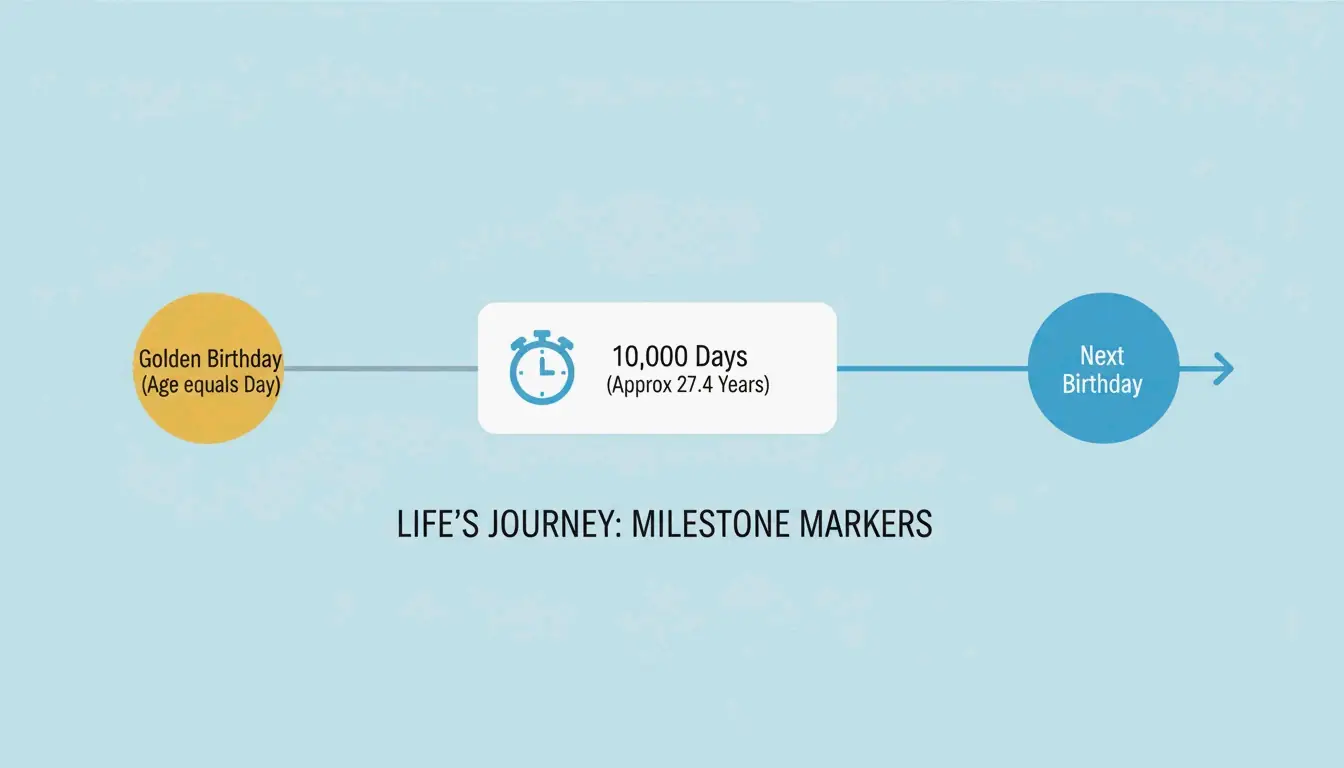
A birthday is the anniversary of a person’s birth — or, figuratively, the birth of an institution — as Wikipedia defines it. The distinction that matters for everything below is between a birth day and a birth date. The birth day comes around every year: January 15 is January 15. The birth date is the complete timestamp, like January 15, 2001. Paste that timestamp into a birthday calculator and you get both back at once: the day of the week you were born, your zodiac sign and birthstone, and how many days remain until the next anniversary.
That calendar-based reckoning — not an hour-by-hour count — is exactly what makes the birthday paradox work. Two people match if they share a month and day, no matter what year they were born.
What counts as a birthday fact — and what we leave out
This guide sticks to five verifiable categories: statistical distributions and rankings; birth month symbols (zodiac sign, birthstone, birth flowers); celebrity birthdays and age calculation; history and cultural practice; and probability math.
Deliberately excluded: any claim that a birth month determines personality, destiny, or guaranteed health outcomes. Birth month associations do surface occasionally as weak, dated correlations in research, and those show up in Chapter 7 with their sample years attached — never as predictions about a specific person.
One reader trap worth flagging early: sharing a birthday with someone does not mean sharing a birth year. Working out age always takes the birth year plus today’s date.
How we source and date every fact in this guide
Every data point below carries its source and, where relevant, its year. Statements fall into two buckets: historical analyses (such as the 2006 New York Times birth-date table) and current facts (such as Google’s 2026 anniversary count).
When a study is more than a few years old, treat it as a reference value, not a snapshot of the present. That rule applies to the 2011 longevity research and the 2014 athletic-development reporting cited later — both still useful, neither a current-year finding.
Birthday Statistics: The Most Common Birthday and Why the Calendar Isn’t Flat
If you only remember one number from this section, make it this: September 16 is the most common birthday in the United States. Everything else here explains why the calendar year is lopsided instead of evenly spread — and which dates sit down at the low end.
What is the most common birthday in the United States?
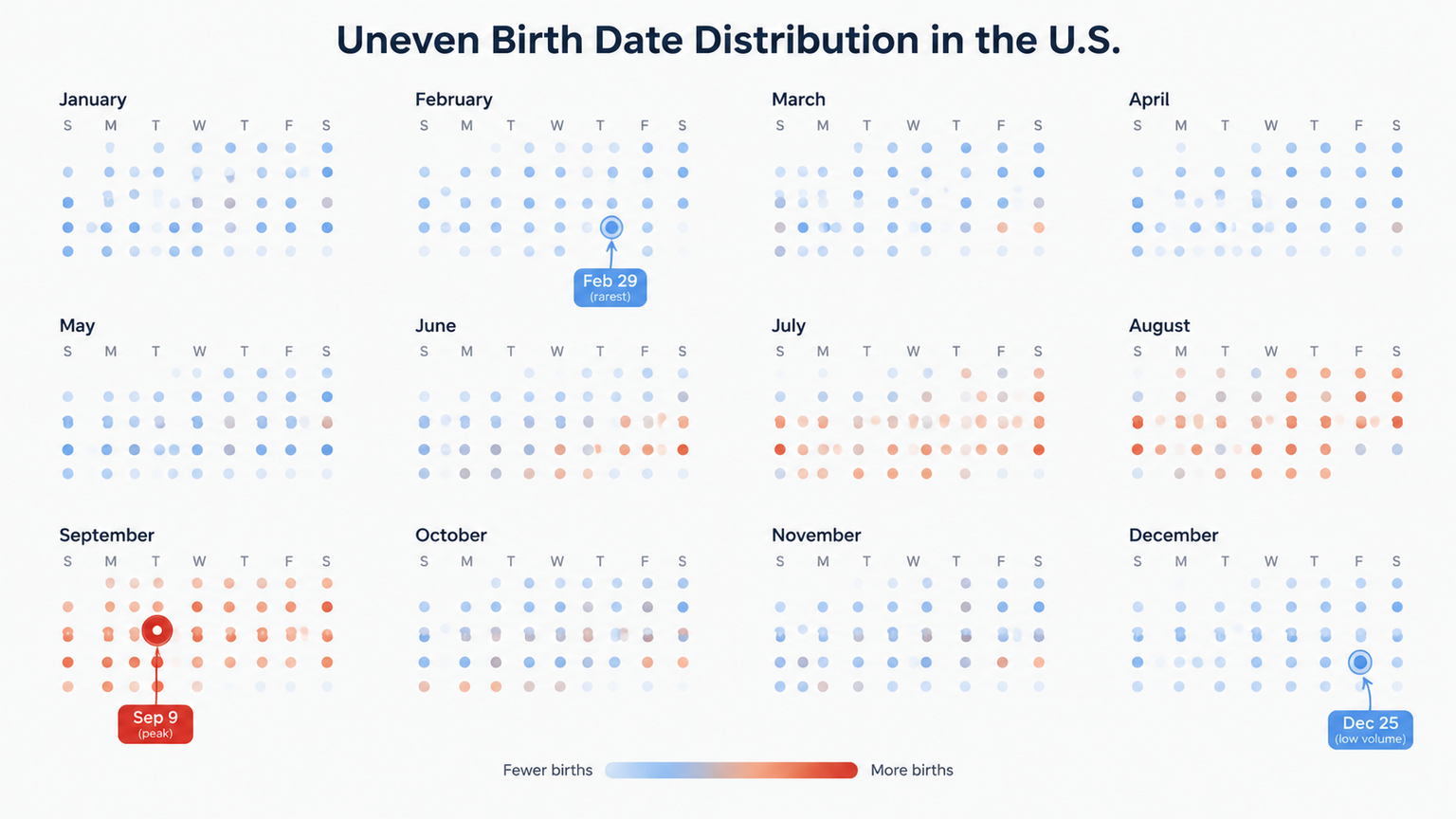
Researchers at Harvard University analyzed US birth records and found that September 16 is the most common birthday in the United States — with September 9 right behind at No. 2 — as reported by The New York Times in 2006.
That dataset is still the most widely cited baseline for US birth-date distribution, which is why the year stays attached here. It’s a historical analysis, not a live count — if you need current-year figures, check the latest official natality statistics.
September is also the peak birth month overall in the US, not just a single standout date. The busiest stretch of the year runs through late summer and early fall.
One more headline number, as a preview: According to Wikipedia’s “Birthday problem” entry, 23 people are enough for a 50.7% chance that two of them share a birthday, and 70 people push that probability to 99.9%. The full derivation is in Chapter 5.
Why birth dates cluster: seasonality, holidays, and scheduled births
US birth dates aren’t evenly spread, and the causes are mostly mechanical rather than mystical.
Conception seasonality is the first driver. A peak in conceptions nine months earlier shows up as a peak in births — part of why the September window carries so much volume.
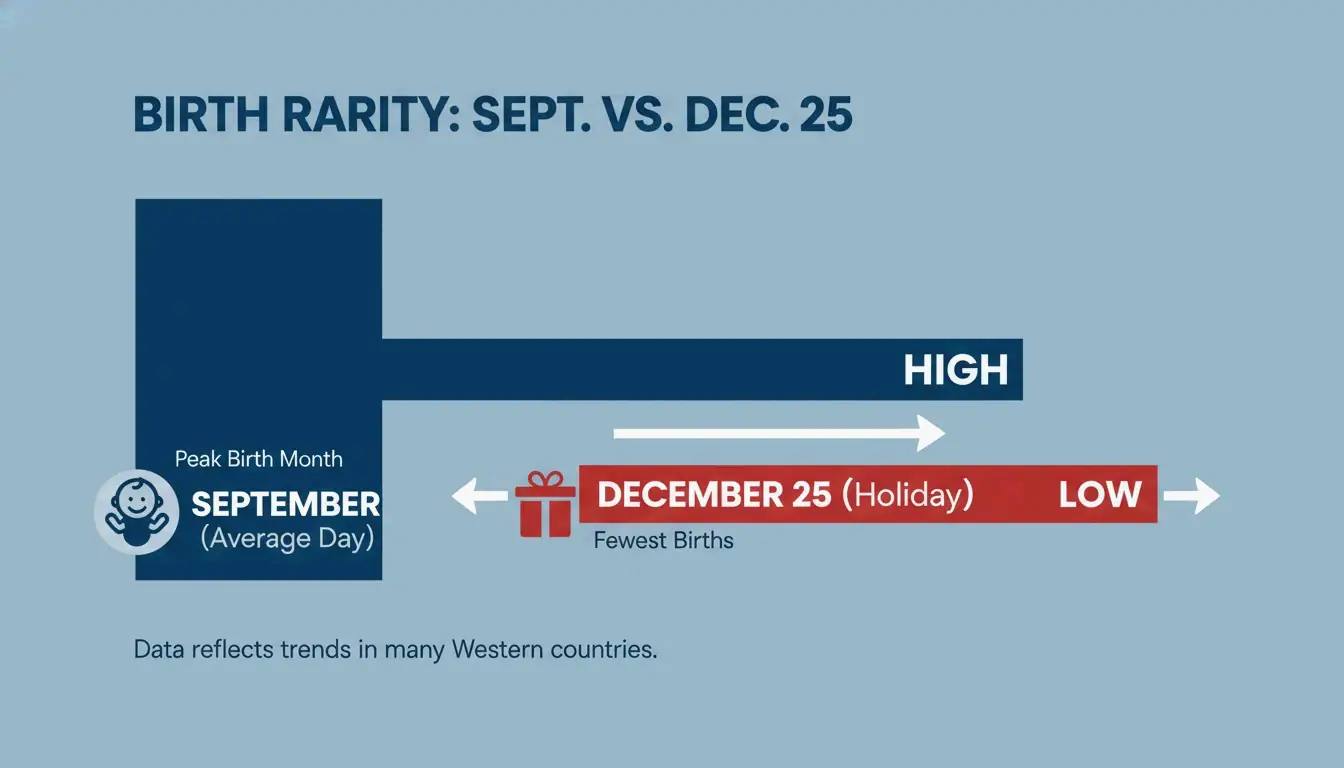
Scheduling is the second. Planned inductions and C-sections tend to avoid weekends and major holidays, which pushes births down on dates like December 25 and January 1 and concentrates them on nearby weekdays. Hospital staffing and operating-room calendars reinforce the same pattern.
So when someone asks why their birthday feels like it keeps colliding with other people’s, the answer is usually that it sits inside one of these high-volume weekday clusters, not on a holiday.
The rarest birthdays: February 29 and December 25
February 29 is the rarest birthday on the calendar because it only exists in leap years. As Wikipedia notes, it’s the one date that doesn’t occur annually — every other birth day comes back each year regardless of the calendar cycle.
Roughly speaking, that date appears about once every 1,461 days, which is why people born on it accumulate “real” birthdays at about a quarter of everyone else’s rate. Chapter 7 covers how that affects legal age and ID renewals in the US.
December 25 sits at the opposite end for a different reason. It’s a real, annual date, but births on it get pushed down by the same holiday-avoidance scheduling that lifts weekday counts elsewhere. The practical upshot: fewer people share Christmas as a birthday than the calendar’s symmetry would suggest.
Birth Month Facts: Zodiac Signs, Birthstones, and Birth Flowers for All 12 Months
Most sites split zodiac signs, birthstones, and birth flowers across three separate pages. The table below puts all three side by side so one lookup answers the whole thing.
The 12-month table: zodiac sign, birthstone, and birth flowers side by side
The zodiac ranges below follow the conventional Western sun-sign boundaries used by the Random Birthday Generator. Birthstones follow traditional month associations.
| Month | Zodiac sign (conventional range) | Birthstone | Birth flower(s) |
|---|---|---|---|
| January | Capricorn (Dec 22–Jan 19), Aquarius (Jan 20–Feb 18) | Garnet | Carnation, snowdrop |
| February | Aquarius (Jan 20–Feb 18), Pisces (Feb 19–Mar 20) | Amethyst | Violet, primrose |
| March | Pisces (Feb 19–Mar 20), Aries (Mar 21–Apr 19) | Aquamarine | Daffodil, jonquil |
| April | Aries (Mar 21–Apr 19), Taurus (Apr 20–May 20) | Diamond | Daisy, sweet pea |
| May | Taurus (Apr 20–May 20), Gemini (May 21–Jun 20) | Emerald | Lily of the valley, hawthorn |
| June | Gemini (May 21–Jun 20), Cancer (Jun 21–Jul 22) | Pearl, alexandrite | Rose, honeysuckle |
| July | Cancer (Jun 21–Jul 22), Leo (Jul 23–Aug 22) | Ruby | Larkspur, water lily |
| August | Leo (Jul 23–Aug 22), Virgo (Aug 23–Sep 22) | Peridot, spinel | Gladiolus, poppy |
| September | Virgo (Aug 23–Sep 22), Libra (Sep 23–Oct 22) | Sapphire | Aster, morning glory |
| October | Libra (Sep 23–Oct 22), Scorpio (Oct 23–Nov 21) | Opal, tourmaline | Marigold, cosmos |
| November | Scorpio (Oct 23–Nov 21), Sagittarius (Nov 22–Dec 21) | Topaz, citrine | Chrysanthemum, peony |
| December | Sagittarius (Nov 22–Dec 21), Capricorn (Dec 22–Jan 19) | Turquoise, zircon | Narcissus, holly |
Two boundary details matter because people commonly get them wrong. Libra covers September 23 through October 22, and Scorpio begins October 23 — the switch does not happen at mid-month. Likewise, Virgo runs from August 23 through September 22, and Leo covers July 23 through August 22.
People born within a day or two of a boundary are often called “on the cusp” — a label the generator notes is conventional, not scientific.
October birthday facts: opal, tourmaline, marigold, and the Libra-to-Scorpio cusp
October is one of the symbol-richest months of the year, carrying two birthstones, two birth flowers, and a zodiac split.
October babies have two birthstones — opal and tourmaline — according to Happiest Baby. Opal is known for its color-shifting quality, while tourmaline comes in multiple shades: black tourmaline is associated with confidence and protection, pink tourmaline with love and compassion, and green tourmaline with strength and stamina.
The month’s two birth flowers are marigold and cosmos. Marigolds, also called calendula, show up frequently in healing lotions, and cosmos is the second traditional bloom for October.
Zodiac placement splits cleanly: birthdays through October 22 fall under Libra, and October 23 onward falls under Scorpio. Since the current date is early October 2026, anyone born this month sits in the Libra-to-Scorpio transition window and inherits both the dual gems and the dual flowers.
September birthday facts: the most common birth month’s symbols
September’s birthstone is sapphire, traditionally linked with wisdom, sincerity, and faithfulness. The classic sapphire is deep blue, though the gem appears in several colors.
September also carries two birth flowers — aster and morning glory. Asters have daisy-like blooms often tied to love and wisdom, while morning glories are known for colorful, trumpet-shaped flowers.
The September zodiac split runs Virgo through September 22 and Libra from September 23 onward. Add in September 16’s status as the most common US birthday, and the month pairs unusually high birth volume with a full set of symbols.
Do birth months predict personality or health?
Birth month and personality are not connected in any way this guide treats as established. Zodiac descriptions are traditionally assigned traits, and the generator itself labels its zodiac ranges as conventional rather than scientific.
The health and performance research that does exist is correlational and date-stamped. Two examples appear in Chapter 7 — a 2011 longevity study and 2014 reporting on athletic development — and both come with specific samples, years, and caveats.
The honest summary: birth month is a real, useful label for symbols and statistics. It is a weak, heavily qualified variable for anything about the actual person.
Celebrity Birthdays: How Age Is Calculated and Why ‘Famous Birthdays’ Became a Data Business
Celebrity birthday pages look simple, but they contain one recurring arithmetic trap. Reading them correctly takes about ten seconds of subtraction.
How to calculate a celebrity’s age in 2026
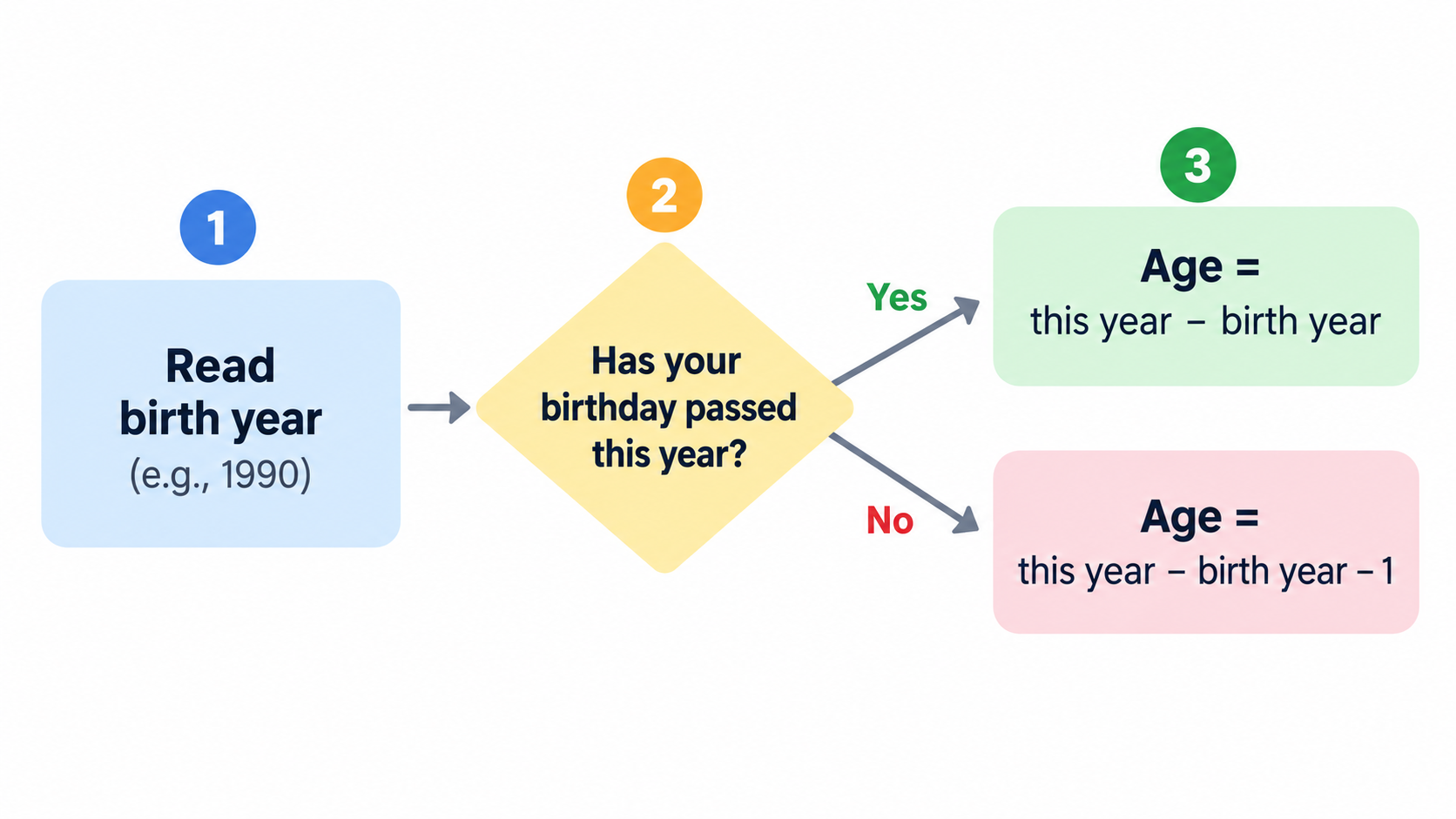
The rule: read the birth year first, then compare today’s date against the birthday. If the birthday has already passed this year, age equals current year minus birth year. If it hasn’t arrived yet, subtract one more.
Keanu Reeves was born on September 2, 1964. As of September 2, 2026, he turns 62; before that date in 2026, he was 61. That parenthetical format — age shown as current-until-birthday — is the standard convention on celebrity birthday pages, and it’s why the same page can show two different numbers a week apart. To skip the subtraction, an online age calculator applies the same rule automatically: enter a birth date and it reads out the exact age as of today.
The same logic applies across the board. Andrea Bocelli, Joan Jett, and Tom Felton all share a September 22 birthday, and Bored Panda’s 2026 list records their ages as 68, 68, and 39 respectively — numbers that only hold from that date forward until the next birthday.
Inside the Famous Birthdays catalog: scale and influence
Famous Birthdays is an American website based in Santa Monica, California, dedicated to cataloging famous people’s birthdays alongside other biographical facts.
Its history has two distinct phases. The original site was created by Edward Morykwas, a Michigan schoolteacher, in 1996, and it offered e-cards. The current format launched on November 7, 2012, under Evan Britton, who has described the site as “Wikipedia for Generation Z.”
The scale figures are the part worth keeping dated: as of January 2018, it held over 150,000 biographies, and as of June 2024, it drew 20 million unique visitors each month.
Its cultural weight is a separate matter. Journalist Taylor Lorenz, writing in 2019, described a Famous Birthdays page as a “status symbol” or “badge of honor” for internet personalities, noting the site’s teenage and Generation Z audience. The site’s growth tracked a shift from traditional celebrities toward internet personalities, after Britton noticed visitors searching for people he did not recognize.
How to read a celebrity birthday list critically
Celebrity birthday roundups are frequently AI-assisted or user-submitted. The Bored Panda list cited above carries an explicit “AI-assisted post” label and credits Wikimedia Commons for its images — a transparency practice worth checking for.
For casual sharing, that’s fine. For citation, the reliable move is to trace the birth date back to a primary or well-documented secondary source rather than repeating the aggregator.
Age deserves a second caution. Any list that hard-codes an age without a reference date will drift out of accuracy within twelve months. Treat every stated age as valid only for the date it was published.
The Birthday Paradox: The Math That Makes Birthday Facts Feel Impossible
This is the part of birthday math that reliably surprises people, and it’s genuinely counterintuitive — not a trick.
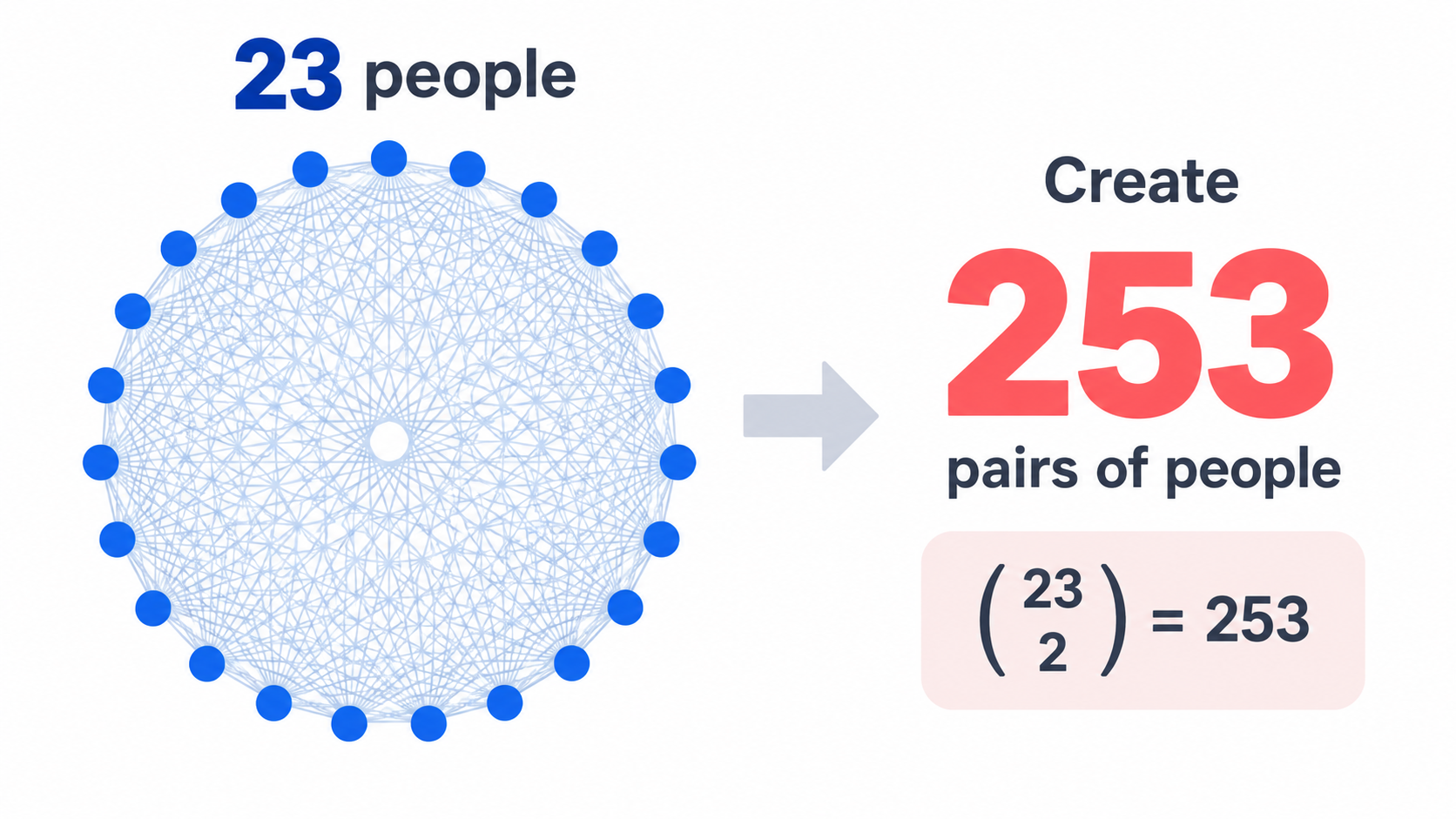
The birthday paradox in numbers: 23 people, 253 pairs, 50.7%
According to Wikipedia’s “Birthday problem” entry, in a group of 23 randomly chosen people, the probability that at least two share a birthday is 50.7%. At 70 people, it reaches 99.9%. At 366, a repeat is guaranteed.
Why it feels wrong: your intuition is answering a different question. People mentally calculate the chance that someone shares their birthday, which stays low. The actual problem compares every possible pair.
With 23 people, there are 23 × 22 ÷ 2 = 253 pairs to consider. That’s the whole trick: 253 comparisons at roughly a 1-in-365 match rate each produces a coin-flip outcome.
Wikipedia’s probability table lays out the curve: 5 people give 2.7%, 10 give 11.7%, 23 give 50.7%, 30 give 70.6%, 50 give 97.0%, and 70 give 99.9%. The problem is generally attributed to Harold Davenport around 1927, though the first published version came from Richard von Mises in 1939.
Real-world proof: shared birthdays among the Apollo astronauts
The most frequently cited real-world example comes from the lunar astronauts. Among 24 Apollo astronauts, there are 276 comparable pairings, and 3 of those turn out to be shared birthdays — as illustrated in the birthday-attack comparison chart in Wikipedia’s birthday problem article.
That’s a small sample behaving exactly as the math predicts, and it makes a clean classroom demonstration: the group is small enough to list by name and large enough that the match isn’t a fluke.
Why tech cares: birthday attacks, hash collisions, and test data
The same structure that produces party surprises also breaks cryptographic assumptions. The birthday attack uses this probabilistic model to cut down the complexity of finding a collision for a hash function, and the same math estimates collision risk for a given population size.
The practical rule: the expected number of N-bit hashes generated before a collision is not 2^N but roughly 2^(N/2). Wikipedia’s comparison table shows the collision thresholds across hash sizes, with the birthday problem placed alongside a SHA-256 example using 16 variants each of benign and harmful contracts — 1 collision appeared out of 256 pairings.
The birthday problem has non-security uses too. It has been applied under the name capture-recapture statistics to estimate fish populations in lakes, and it’s a standard tool for modeling coincidences and for stress-testing data pipelines where duplicate keys are assumed to be rare.
Birthday History and Culture: Cake, Candles, Wishes, and Coming-of-Age Milestones
Modern birthday customs blend ancient ritual, medieval naming practice, and industrial-era economics.
Where birthday cake and candles come from
One origin thread traces the candle-topped cake to ancient Greece, where round cakes topped with lit candles were offered to Artemis, with the round shape referencing the moon. A second thread runs through 18th-century Germany and the Kinderfeste tradition, where a cake with candles marked a child’s birthday.
The most repeated explanation — that the smoke carries the wish to the gods — is an inherited piece of custom rather than a documented historical fact, and it should be described that way.
The mechanics of the modern wish are better documented. As Wikipedia notes, a birthday cake may be decorated with the person’s name and age, or studded with as many lit candles as the person’s age. The celebrant makes a silent wish and tries to blow out every candle in one breath; if they succeed, superstition holds the wish will be granted. In many cultures the wish has to stay secret or it won’t come true.
The shift from aristocratic custom to mass practice came with economics. Falling sugar prices after the Industrial Revolution and the spread of commercial baking made cake affordable well beyond the nobility.
Coming-of-age birthdays: Sweet 16, quinceañera, bar/bat mitzvah
Different cultures mark the same biological milestone with different birthdays and different ceremonies.
In Canada and the United States, families often mark a girl’s 16th birthday with a “sweet sixteen” celebration — something popular culture has reinforced heavily. In some Hispanic countries and in Brazil, the quinceañera — or festa de quinze anos — traditionally marks a girl’s 15th birthday.
Jewish boys have a bar mitzvah on their 13th birthday. Jewish girls have a bat mitzvah on their 12th birthday, or sometimes on their 13th in Reform and Conservative Judaism. As Wikipedia explains, this marks the transition where they become obligated in commandments from which they were previously exempted and are counted as part of the community.
Japan’s Coming of Age Day celebrates everyone who has turned 18. The Philippines holds a debut for young women at 18 and young men at 21. Korea marks both Baek-il, the 100th-day feast, and Doljanchi, the child’s first birthday.
How different countries mark the same day
The core legal concept is shared even where customs diverge. In most legal systems, a person becomes a legal adult on the birthday when they reach the age of majority — usually somewhere between 12 and 21 — and specific ages unlock specific rights: leaving full-time education, military enlistment, marriage with or without parental consent, voting, running for office, buying alcohol or tobacco, buying lottery tickets, or getting a driver’s license.
Some places complicate the counting itself. In China, traditional birthdays were reckoned using the lunisolar calendar, which can vary from the Gregorian calendar by as much as a month in either direction; celebrating the lunisolar birthday remains common in Taiwan while growing less common on the mainland. South Korea used multiple age systems until June 2023, when all Korean ages were set back at least one year and official ages became reckoned only by birthdays.
One more wrinkle worth knowing: many cultures also observe a name day, or saint’s day — celebrated much like a birthday, but keyed to the saint sharing the person’s name rather than their birth date.
US Birthday Facts: Peak Dates, Age Milestones, and Being Born on February 29
This section concentrates the US-specific data readers most often need to cite, with each figure’s year attached.
US birth distribution: peak months and the quietest dates
The headline US figure is still September 16 as the most common birthday, based on a Harvard University analysis of US birth records reported by The New York Times in 2006. September is the busiest birth month overall.
The quietest stretch of the calendar runs through weekends and major holidays, where scheduled deliveries are deliberately steered away. December 25 and January 1 are the standard examples. February 29 is the rarest date overall because it only exists in leap years.
Cross-referencing with symbol data adds a practical detail: a September 16 birthday falls under Virgo (Virgo runs through September 22), carries sapphire as a birthstone, and picks up aster and morning glory as birth flowers.
Age milestones in the US: what actually changes at 18 and 21
Two ages carry the most cultural weight in the US. Eighteen is generally when voting rights and legal adulthood arrive in most states; 21 is when the drinking age applies nationwide.
Beyond those two, the picture fragments. Renting a car, signing a contract, buying a firearm, and other rights vary by state — and whether a right activates on the birthday itself or on a different administrative date depends on the jurisdiction and the specific law.
The safe way to phrase any of these: reaching 18 or 21 marks the general threshold, but the exact effective date and scope should be checked against the relevant state’s rules, not assumed.
Leap day birthdays: legal age, ID renewals, and party math
February 29 births create a set of small but real administrative questions. Because the date doesn’t occur in non-leap years, US practice commonly treats February 29 babies as reaching a given age on March 1 or February 28 of non-leap years for legal and identification purposes.
The generator tool’s software convention offers a useful contrast: it advances February 29 ages on March 1 in non-leap years, and explicitly labels that as a software convention rather than a legal age rule. That distinction is worth keeping — agencies and systems don’t all handle it the same way, so a leap-day birthday is one case where checking the specific rule ahead of time saves trouble.
The celebratory math is simpler. A February 29 baby accumulates roughly one quarter as many “actual” birthdays as peers of the same age, which is why many choose February 28 or March 1 for parties in common years.
One more US data point worth carrying with its year: a 2011 study in the Journal of Aging Research found that people born from September to November were more likely to reach age 100 than those born in other months. The study compared American centenarians with their siblings and spouses, and it’s a historical analysis rather than a current-year finding.
A second dated finding: research reported by The Guardian in 2014 indicated that autumn-born children showed stronger athletic performance, with the leading explanation being the “relative age effect” — being older and bigger than classmates within the same school cohort. Both findings are correlational, and neither predicts an individual outcome.
Time-Sensitive Birthday Facts for 2026: Google’s Birthday and Today’s Celebrity Lineup
This section holds the numbers that change from year to year. Last updated: October 2026.
When is Google’s birthday, and how old is it in 2026?
Google’s birthday has a genuine ambiguity built into it. The company was incorporated on September 4, 1998, but it officially celebrates its birthday on September 27 each year — and ClickOnCare’s 2026 milestone summary notes that tradition has been tied to September 27, with the celebration reported as running since 2002.
In 2026, Google marks its 28th birthday. The 1996 predecessor project, “Backrub,” was built by Larry Page and Sergey Brin at Stanford; the domain google.com was registered in 1997, and the company was officially founded in 1998.
That gap between incorporation date and celebration date is the interesting part. A business can pick a birthday; a person can’t.
Today’s celebrity birthdays: how to keep this section current
Daily celebrity birthday lists exist at scale. Bored Panda maintains a running Celebrity Birthdays hub with daily posts, and the September 22, 2026 edition lists ten figures: Andrea Bocelli, Joan Jett, Tom Felton, Tatiana Maslany, Billie Piper, Bonnie Hunt, Nick Cave, Teyonah Parris, Mireille Enos, and Jessie Murph.
The ages in that list — 68, 68, 39, 41, 44, 65, 69, 39, 51, and 22 — were correct as of September 22, 2026 and change on each person’s next birthday. Apply the Chapter 4 formula instead of copying the number.
This is the section readers should re-check rather than trust from memory. Any age, anniversary count, or daily lineup listed here carries an implicit expiration date.
How to Use These Birthday Facts: Party Icebreakers, Classroom Math, and Content Ideas
The data above works better as an activity than as a fact list. Here are three settings where it shines, plus one tool that removes the manual labor.
Party and classroom activities using birthday statistics
The strongest opener is the 50.7% figure from Wikipedia’s birthday problem entry. At a gathering of 23 or more, announce the number, then have guests pair up and compare birthdays. The result validates the paradox live, and the explanation — 253 pairs, not 22 comparisons — is the payoff.
For a classroom, run the same activity, then move to the Apollo astronaut case: 24 astronauts, 276 pairings, 3 shared birthdays. Students can check the predicted range against a real, nameable group, which turns an abstract probability lesson into a data-checking exercise.
The extension for advanced groups is the birthday attack. Same math, different stakes: a collision that’s a party trick in one context is a security vulnerability in another.
Generating sample birthday data for tests, games, and content
Manual birthday generation doesn’t scale. The Random Birthday Generator produces fictional dates in batches of up to 1,000, with three generation modes: age range, custom date range, or month-and-day only (no birth year).
Each result can include the date, calculated age, weekday, Western zodiac sign, and birthstone. Exports come as CSV or JSON, and there’s a no-duplicates option plus an explicit February 29 toggle. Everything runs in the browser — the tool states that generation, exports, and card creation happen on the user’s device, with no account required.
The intended uses are character profiles, tabletop games, form and calendar testing, and classroom sampling. The tool’s own documentation is clear that results are fictional sample data and should never be used as identity information, for verification, or in official records.
One implementation detail worth knowing if you’re building on top of it: the tool labels its zodiac ranges as approximate Western sun-sign dates intended for entertainment, and its birthstones as traditional month associations.
Content and quiz ideas built on birth month symbols
The 12-month table in Chapter 3 is designed to be reused directly. Three recurring formats work well:
- Month symbol posts. One month per post, combining its zodiac range, birthstone, and birth flowers. Chapter 3 covers September and October as worked examples.
- Same-day challenges. Pair a shared birthday (like September 22, 2026) with the ages and the paradox math to produce a “who else shares your day” post.
- Quiz questions. Turn the probability table into a five-question quiz: how many people for 50.7%? How many for 99.9%? How many pairings exist among 23 people?
Any content built this way should carry its source and year, exactly as this guide does.
Conclusion
Birthday facts are a set of verifiable data points: a 50.7% shared-birthday chance at just 23 people, September 16 as the most common US birthday, and a full 12-month table of zodiac signs, birthstones, and birth flowers. Use this guide selectively — cite Chapters 2 and 7 for US statistics with their years attached, run the Chapter 9 activities for parties and classrooms, and export CSV or JSON from the generator when you need sample data in bulk. Any number that changes over time should be re-checked against the last-updated date noted in each section.
FAQ
What is the most common birthday in the United States?
September 16, according to a Harvard University analysis of US birth records reported by The New York Times in 2006. September 9 is a close second in the same dataset. September as a whole is the peak birth month, while weekends and major holidays see noticeably lower birth rates because scheduled deliveries avoid them. That figure is a historical dataset — check current official natality statistics for year-by-year data.
How many people need to be in a room for a 50% chance of a shared birthday?
Twenty-three people produce a 50.7% probability. The reason: the comparison covers every pair, not just one person against the rest — 23 people create 253 pairs. At 70 people the probability reaches 99.9%, and at 366 a repeat is guaranteed. Among 24 Apollo astronauts, 3 shared birthdays appeared across 276 pairings.
Which birthstones and birth flowers belong to October babies?
October carries two birthstones, opal and tourmaline, and two birth flowers, marigold and cosmos. Opal is known for its shifting color, and tourmaline appears in black, pink, and green varieties. On the zodiac side, Libra runs through October 22 and Scorpio begins October 23, so an October birthday falls on one side of that split.
Why do we make a wish and blow out candles on a birthday cake?
One origin thread traces the practice to ancient Greece, where round cakes with lit candles were offered to Artemis — the round shape referencing the moon. A second thread runs through the 18th-century German Kinderfeste tradition of a candle-topped cake. The popular explanation that smoke carries the wish to the gods is inherited custom rather than documented history.
When is Google’s birthday, and how old is Google in 2026?
Google was incorporated on September 4, 1998, but officially celebrates its birthday on September 27, a tradition reported as running since 2002. In 2026, Google marks its 28th birthday. The split between incorporation date and celebration date is common for companies, and contrasts with a person’s single legal birth date.